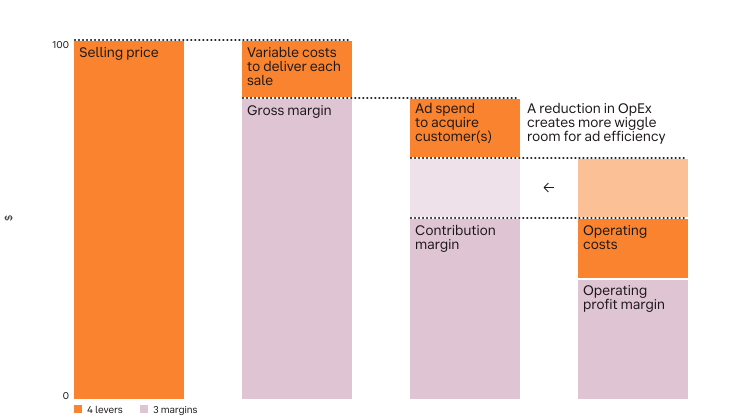
One of the innate traits of consumer product brands is that you can build a business with low operating leverage. But what does "operating leverage" mean in practice?
In simple terms, the higher your fixed operating costs are (in proportion to your total costs), the higher your operating leverage is.
Low operating leverage can be hugely beneficial, giving you the flexibility to shrink costs in response to declining revenue. In a downturn, it could be the difference between survival and bankruptcy.
The exact formula you can use is as follows:
operating leverage = contribution margin / operating profit
High operating leverage isn't inherently bad. It allows you to benefit from higher margins when sales are increasing.
But leverage always works both ways. In turbulent times, high operating leverage is not good, because you're left with fixed cost obligations even as sales dip.
To really bring this concept to life, let's walk through an example that compares the unit economics of BizA and BizB side-by-side.
Both sell a very similar product, but there's a key operating difference to note: BizA manufactures their products in-house with full-time employees, while BizB source their product from a third-party manufacturer.
As you can see, the decision to manufacture in-house has widened the gross margins of BizA. Product costs are lower, they spend less on freight, and fulfillment is cheaper because they pick and pack in their own warehouse.
But you'll also notice that their fixed operating costs are much higher than BizB. By moving operations in-house, they've added additional fixed operating costs like salaries, rent and electricity.
In contrast, because BizB outsources manufacturing, they pay a higher variable cost per unit, but in doing so they are able to run their business with a much leaner OpEx figure.
Now let's assume both businesses have the same marketing efficiency ($45 to acquire each customer) and sell the same number of units (10,000).
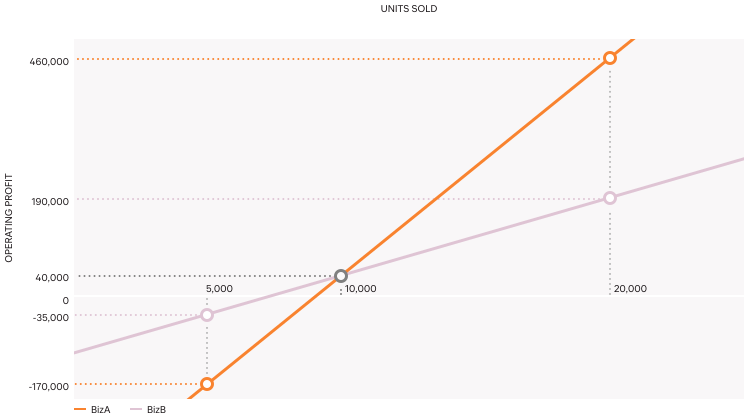
As it turns out, despite having a different ratio of variable:fixed costs, both businesses have generated the same operating profit of $40,000 at this sales volume.
So it's much of a muchness, right? Not so fast. It's only when you consider fluctuations in sales that the concept of operating leverage becomes really important.
If we apply the above formula to each business, we can calculate their "operating leverage" to be 10.50 and 3.75 respectively. BizA is much more "leveraged" than BizB.
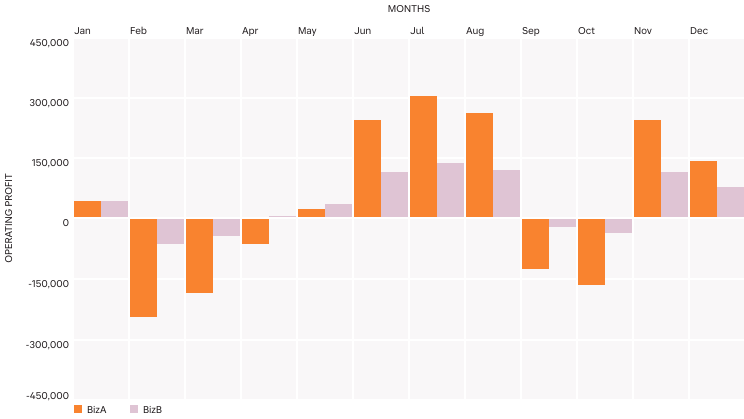
For them, a 1% increase in sales leads to a 10.5% increase in operating profit. But the reverse is also true. If sales drop suddenly, their operating profit takes a significant hit.
You can visualize a series of "what-if" scenarios on a graph to really understand this concept.
What if both businesses sold double the number of units? What if they sold half? As you can see, BizA's high operating leverage makes them much more prone to wild swings in operating profit.